 By Chris Follin
TRAILER SKILLS
How to back up a trailer
Backing a trailer is not a confidence contest. It is a slow geometry problem. Set up the approach, use tiny steering inputs, watch the trailer tires, and pull forward before the angle turns into a fight.
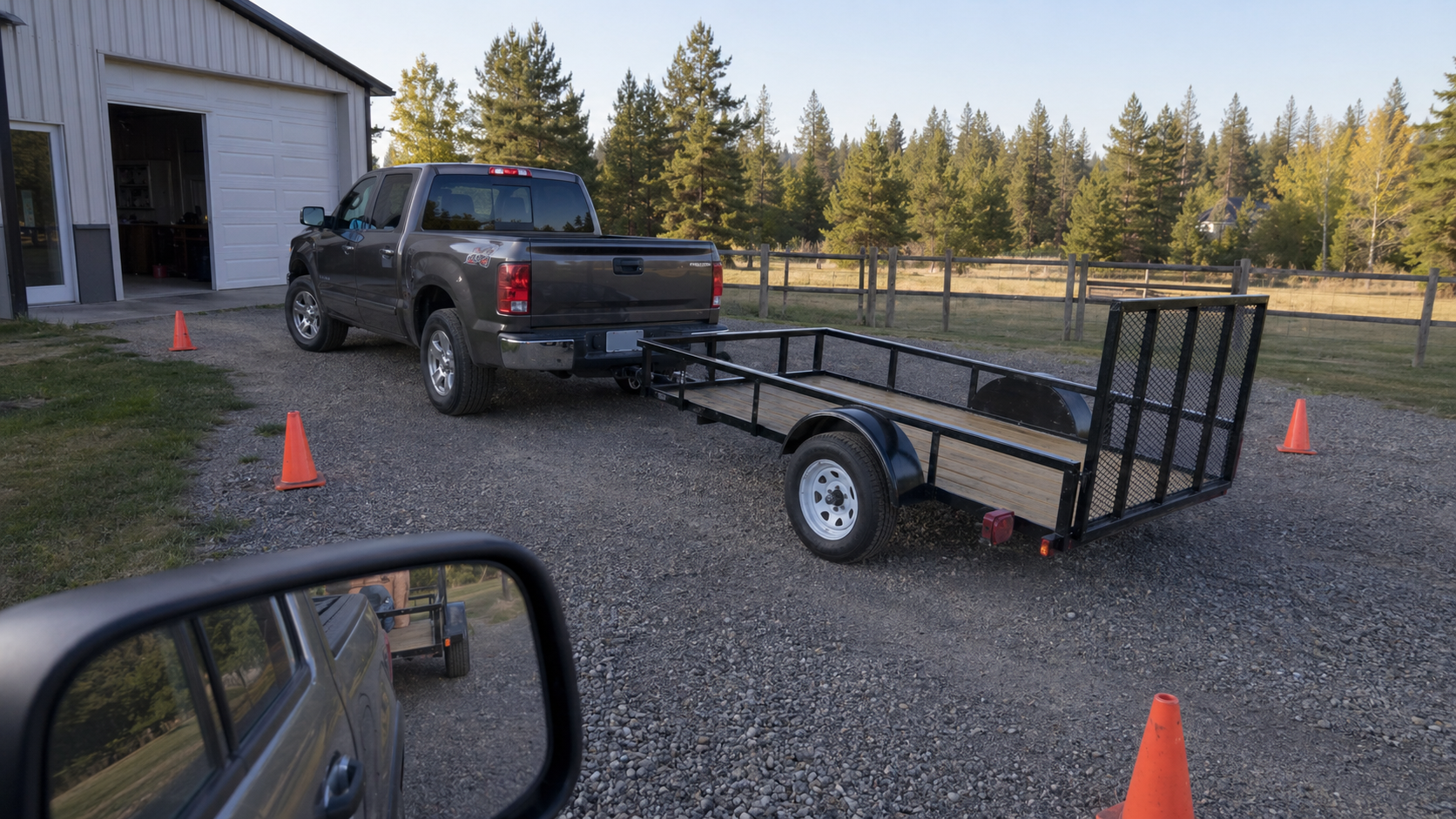
The setup matters more than the save
Most backing problems start before reverse. If the truck and trailer begin at a bad angle, you spend the whole maneuver trying to rescue it. Pull past the opening, give yourself room, and start with the trailer as straight as possible.
Watch the trailer tires, not just the back corner. The tires tell you where the trailer is actually going. Small steering inputs change the angle. Big inputs create drama, especially once the trailer is already turning.

BACKING FLOW
Set up, start, catch, reset
Backing is not one continuous move. It is a series of small corrections with permission to pull forward before the angle gets stupid.
- 1. Pull pastGive the trailer room to enter the spot without starting jackknifed.
- 2. Start slowIdle speed gives your brain time to see the trailer react.
- 3. Watch tiresThe trailer tires show where the trailer is actually going.
- 4. Pull forwardReset early instead of trying to save a bad angle with more steering.
Spotter rule
One spotter, one signal language, visible in the mirror. If you lose sight of the spotter or anyone walks behind the trailer, stop.
CAMPSITE BACK-IN
Backing is only half the job
A campground back-in is not just "can I fit?" It is also doors, awning, hookups, slope, trees, fire ring, slide-outs, and where people will walk once camp is set.
| Before reverse | Look for | Decision |
|---|---|---|
| Hookups | Power pedestal, water spigot, sewer, or generator clearance. | Choose the side and depth before you start backing. |
| Overhead | Branches, roof corners, awning space, antenna, ladder, and slope changes. | Stop and walk it if you cannot see it from the mirror. |
| Living side | Door swing, steps, picnic table, fire ring, mud, and traffic. | Favor the side where camp will actually work, not just where the trailer barely fits. |
| Escape path | Road width, ditch, posts, rocks, and neighbors' vehicles. | Leave enough angle and room to pull out without a ten-point mess. |
Understand the direction
With your hand at the bottom of the steering wheel, move your hand toward the direction you want the trailer to go. That trick is not magic, but it gives your brain a useful shortcut while you learn.
Once the trailer begins turning, unwind the wheel before the angle gets too sharp. You are not just starting the turn. You are also catching it.
Use a spotter without making it worse
A spotter should stand where the driver can see them in the mirror and where they are not in the path of the trailer. Agree on signals before moving: stop, driver side, passenger side, keep coming, and pull forward.
If you lose sight of the spotter, stop. If two people start giving directions, stop. If anyone walks behind the trailer, stop.
Practice the boring moves
Practice straight backing, gentle turns, and recovering from a bad angle. Set cones for a driveway or campsite entrance. Back in, pull out, do it again. One perfect hero attempt teaches almost nothing. Repetition teaches you how the trailer reacts before you are tired and blocking a road.
Short trailers react faster than long trailers. Empty trailers may bounce and pivot quickly. Camp trailers add width and blind spots. Treat each trailer like a new tool until you feel its timing.
Keep backing
- You stop before the trailer angle gets ugly.
- The spotter stays visible and uses one signal language.
- You pull forward early and reset calmly.
Pull forward and reset
- You add throttle to fix a steering mistake.
- The trailer disappears from both mirrors.
- People stand near the pinch zone or behind the trailer.
Field note
Back at the speed you are willing to hit something. That usually means barely moving.