 By Chris Follin
DRIVING SKILLS
How to back into a campsite
Backing into a campsite is not just parking a trailer. It is placing the little house so the door, hookups, awning, table, fire ring, shade, slide-outs, leveling, and exit path all make sense after you unhitch.
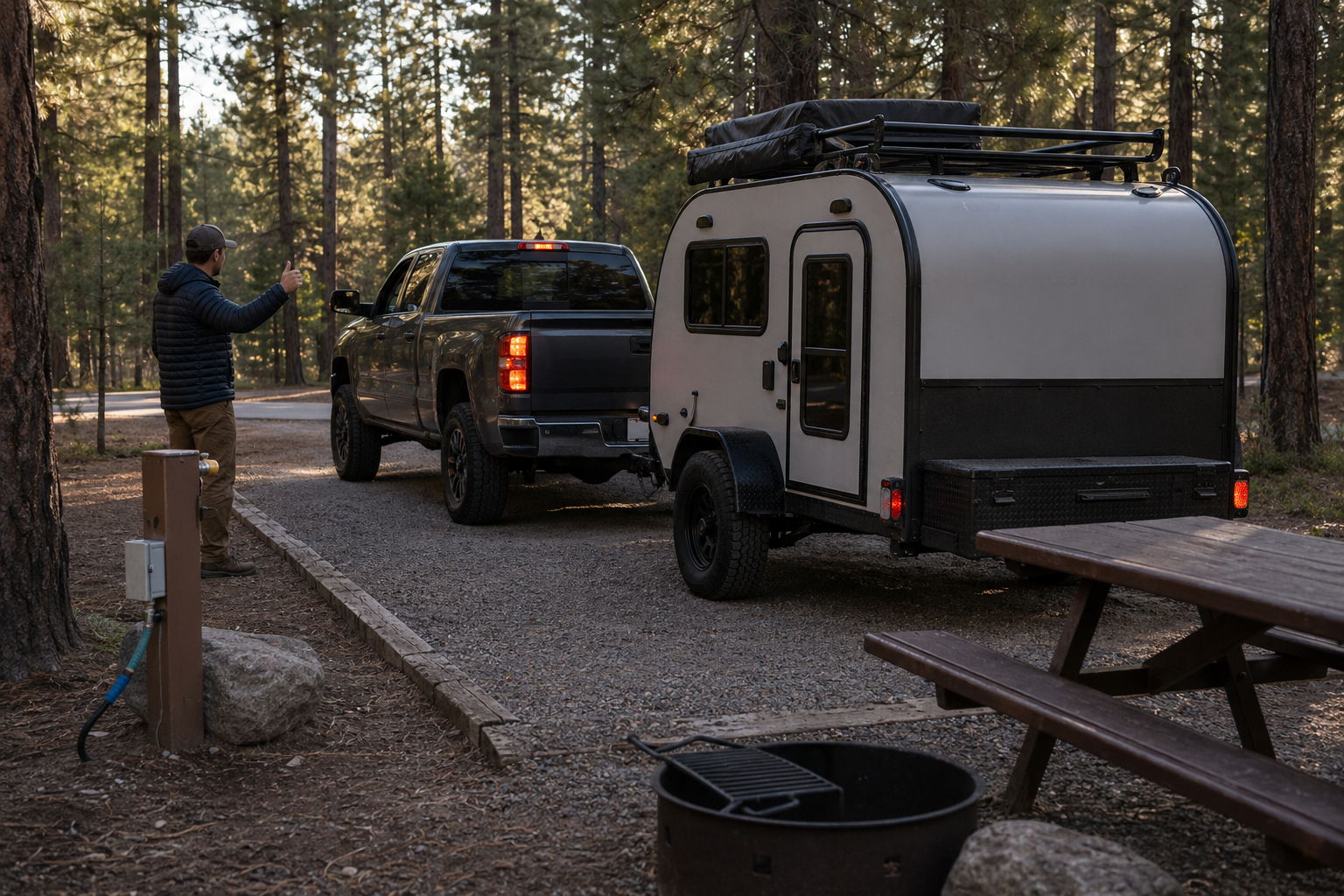
Place the campsite before you place the trailer
The mistake is treating the pad like the destination. The pad is only one part of the campsite. The real question is where the door opens, where the awning lands, where the table sits, where the fire ring throws smoke, and whether the hookups reach without turning the site into a hose obstacle course.
| Thing to place | What to look for | Why it matters |
|---|---|---|
| Living side | Door, steps, awning, table, fire ring, and the normal walking path. | The trailer can be perfectly straight and still make camp feel stupid if the door opens into the wrong side. |
| Utility side | Power pedestal, water spigot, sewer drop, hose length, and cable path. | Hoses should reach without crossing the doorway or forcing the trailer into a bad living position. |
| Leveling side | Low side of the pad, room for blocks, and where tires will land. | Know the level plan before the wheels are exactly where you want them. |
| Exit angle | Truck swing, trees, posts, neighbor vehicles, and road width. | You still need to leave. Do not trade a clean arrival for an ugly departure. |
- Walk the siteDo this before backing. Look up, look down, find utilities, and decide what "done" should look like.
- Pick the living areaDoor, awning, table, and fire ring should make one usable camp, not four disconnected problems.
- Mark the stop pointUse a cone, rock, spotter position, or mental line so the driver is aiming for an actual finish.
- Back slow, then re-checkStop before the last adjustment, get out, and fix the final position before chocking or unhitching.
The walk-around before backing
- Find the utilities and decide whether they define the final position.
- Look up for branches, lantern hooks, signs, and anything that can hit roof gear or an awning.
- Check the ground slope from side to side and front to back.
- Locate table, fire ring, grill, tent pad, and the path people will use at night.
- Pick a stopping point, not just a general direction.
How to back it in without drama
- Pull past the site farther than you think so the trailer has room to angle.
- Use small steering inputs and go slow enough that stopping never feels sudden.
- Have the spotter stand where you can see them and where they can see the blind side.
- Pull forward early. A pull-up is not failure; it is how you erase a bad angle.
- Stop, check final placement, then make the last correction before unhitching.
After the trailer is positioned
Do the boring sequence: chock, level, unhitch, stabilize, connect utilities, then open awnings or slides. Opening the living area before the trailer is stable and level is how small mistakes become bigger ones.
The site will work
- Door, awning, table, and fire ring make a logical living area.
- Hookups reach without crossing the main walking path.
- The trailer can be leveled without extreme blocks or sketchy stacking.
- You can pull out without a heroic multi-point escape.
Fix it before unhitching
- The door opens into the utility post or brush.
- The awning would hit a tree or cover the wrong area.
- The sewer or water connection creates a trip line.
- The truck is trapped by the final trailer angle.
Field note
A campsite is not parked until it is livable. If the trailer is straight but the site layout is bad, you are not done.