 By Chris Follin
BATTERY SKILLS
How to test a car battery
A multimeter can tell you whether a 12V battery is obviously low, charging, or suspicious. It cannot fully load-test the battery by itself, so treat voltage as a first clue, not a full diagnosis.
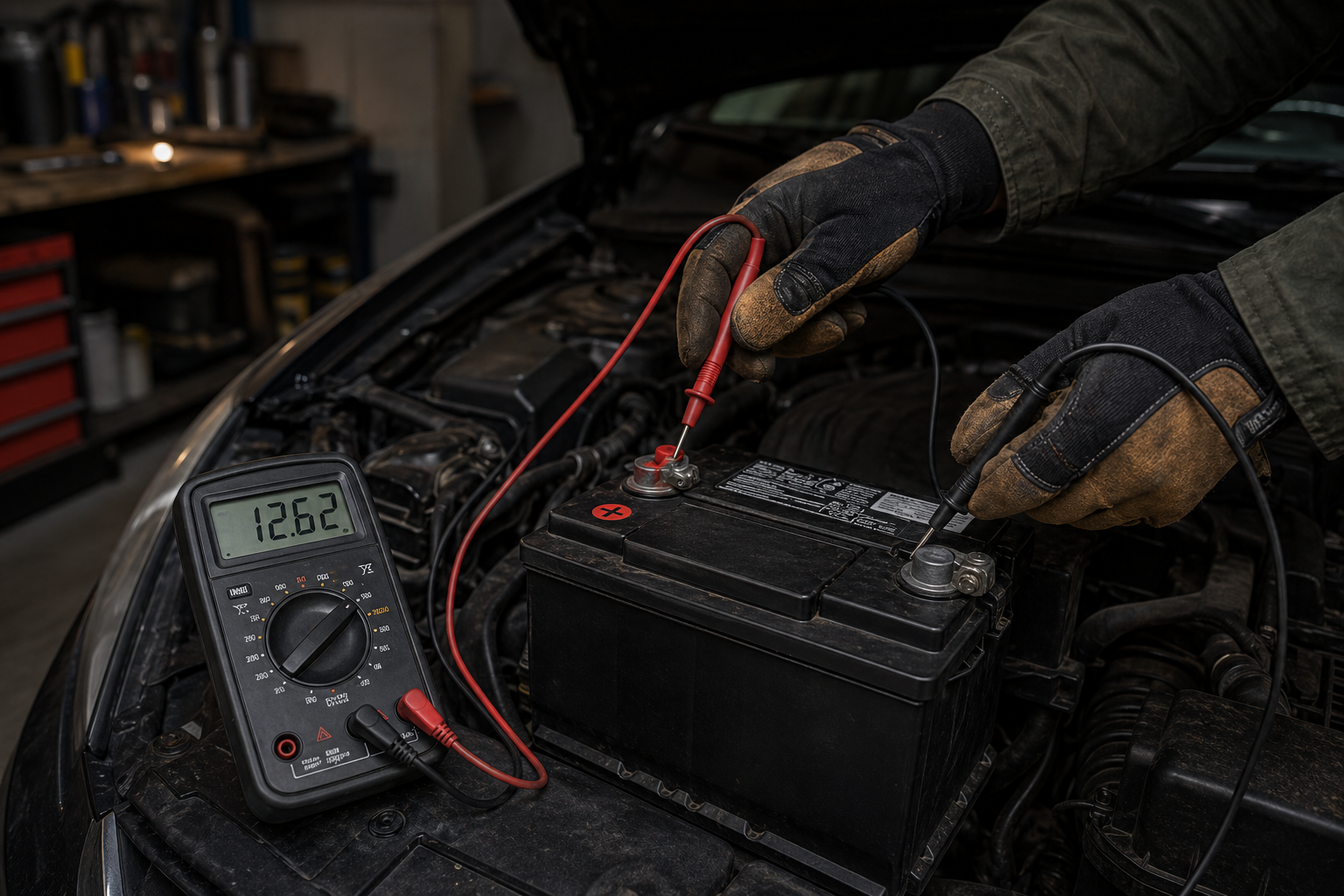
Voltage is a clue, not a verdict
A battery can show decent voltage and still fail under load. That is why shops use load testers or conductance testers. Still, a multimeter is useful. It can tell you if the battery is deeply discharged, if the charging system appears to be charging, or if you need to stop blaming the starter.
Measure at the battery posts, not just the cable clamps, if you want the cleanest battery reading. Then measure at the clamps if you suspect dirty or loose connections. A difference between the two can point toward terminal problems.
QUICK DIAGNOSIS
Separate battery, connection, and charging clues
Do not let one number do all the work. A battery can be charged but weak, low because something drained it, or fine while the cable connection is the real problem.
| What you see | Likely direction | Next move |
|---|---|---|
| Good voltage at posts, lower voltage at clamps | Terminal or cable connection problem. | Clean and tighten connections, then retest at both places. |
| Voltage looks okay, cranking falls hard | Weak battery, bad connection, or excessive starter draw. | Get a load/conductance test and inspect cables/grounds. |
| Resting voltage low after sitting overnight | Discharged battery, parasitic draw, old battery, or short-trip use. | Charge fully, retest after rest, then check for draw if it repeats. |
| Running voltage never rises | Charging system may not be charging normally. | Check belt, alternator output, fuses, wiring, and vehicle-specific smart charging behavior. |
READ THE NUMBERS
What voltage can tell you
These are useful lead-acid battery clues, not absolute verdicts. Temperature, surface charge, battery chemistry, and vehicle electronics can all move the number.
| Reading | What it suggests | What to do next |
|---|---|---|
| 12.6V or higher | Usually charged at rest for a conventional lead-acid battery. | If it still cranks poorly, look at terminals, grounds, starter draw, or get a load test. |
| About 12.4V | Partly discharged, often around the middle of the state-of-charge range. | Charge it fully before making a replacement decision. |
| About 12.2V | Significantly discharged. | Charge it fully, then retest after it rests. |
| 12.0V or lower | Very low or deeply discharged. | Charge slowly and investigate why it got there. |
| 13.5V to 14.7V running | Common charging range on many vehicles. | Confirm against the vehicle spec if smart charging behaves differently. |
Resting voltage check
Turn the vehicle off and let it sit if possible. Put the red probe on positive and black probe on negative. A fully charged lead-acid battery is commonly around 12.6 volts or higher at rest. Around 12.2V is significantly discharged. Around 12.0V or below is very low.
Temperature and battery chemistry matter, so do not treat the numbers as courtroom evidence. Use them as a first read.
Charging check
Start the engine if the vehicle can start. Measure across the battery again. Many vehicles will show roughly 13.5V to 14.7V while charging, though smart charging systems can vary. If running voltage is still around resting voltage, the alternator, belt, wiring, or charging strategy needs more diagnosis.
Turn on headlights and blower and watch for severe drops. A small change is normal. A collapsing reading is a clue that the system needs attention.
When to get a real battery test
If the battery repeatedly goes dead, cranks slowly, tests low after charging, or passes voltage but still fails to start, get a load or conductance test. Voltage alone cannot measure capacity or internal resistance well enough.
Also inspect the simple stuff: loose terminals, corrosion, bad grounds, parasitic drains, old age, and a vehicle that only takes very short trips.
The battery story is clear
- Resting voltage is around 12.6V or higher after sitting.
- Running voltage rises into normal charging range.
- Terminals are clean and tight.
The numbers are lying by omission
- Voltage drops hard during cranking.
- Running voltage never rises above resting voltage.
- The battery repeatedly dies after being charged.
Field note
A multimeter tells you where to look next. It does not replace a real load test when the answer matters.